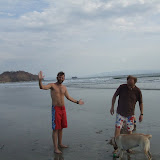
This is crazy....I've had zero time lately for this blog. For the 1 or 2 people that check in on it, my apologies.....
I have a stack of Netflix movies waiting to be watched, including Butch Cassidy and the Sundance Kid and Some Like It Hot. With any luck, I'll get around to posting a review, as well as a long overdue Monday Morning Blues entry.
Take care everyone....
Showing posts with label Movie Reviews. Show all posts
Showing posts with label Movie Reviews. Show all posts
Wednesday, October 3, 2007


Monday, September 17, 2007
Germany Under Fire, Pt. 1
 It's no mistake that I recommend the majority of the movies that I review here. I actively seek out classics, and I wasn't disappointed with the double billing that I took in recently over a bucket of buttery popcorn and a couple rum and cokes. Schindler's List and The Lives of Others.
I'll start with the former, the well-told, yet always disturbing tale of German persecution of European Jewry....the Holocaust, and one man's efforts to save Jews in a forced labor camp deep within Nazi-controlled Poland and Czechoslovakia. I'll spare the details, but suffice it to say, Spielberg's use of black and white cinematography was fitting, as this is a grim story of survival, and far too often, hopeless despair and death. Within this human quagmire, Oskar Schindler, played by Liam Neeson, transforms from a war material entrepreneur hellbent on exploiting a labor force with no future, to a compassionate traitor, with enough money to buy freedom.
A true story, Schindler's List is easily the tour de force of 'Holocaust movies'. Three central characters emerge from the movie. Itzhak Stern, played masterfully by Ben Kingsley, acts as Schindler's confidant and accountant, bridging the gap between German conscience and the the Jewish reality of the war. On the other hand, Amon Leopold Göth is the sadistic, yet internally weak SS prison camp commander, played by Ralph Fiennes. This epic loosely follows the transformation of Schindler, dealing with these two men, and the dependency that they show.
It's a moving film, and I highly recommend to anyone attempting to try to understand such a terrible chapter in modern history. I think it put my wife in labor, to be honest....
Worth the Hype? Absolutely. This is one of those instant classics. It is even better today, than when I initially saw it in 1994. A moving film. Tomorrow, I'll follow up with a take on 'The Lives of Others', a look at the oppressive East German Stasi during the 1980s.
Tuesday, August 28, 2007
High Noon

Gary Cooper, Grace Kelly, Tex Ritter songs....need I say more? The classic arch-type Western. Or is it? Honorable lawman versus the yellow-bellied outlaws....a mismatch, showdown in the streets......yet justice prevails.
Despite technical difficulties (thanks Netflix) and a tick infestation of epic proportions (thanks Stella and Managua), we were quite distracted trying to watch this great, albeit short, Western classic.
Thanks to a glitchy DVD and a dog littered with ticks, I had a hard time taking in the subtleties of this flick. Yet, it is interesting to note, in 1952, as the Cold War escalated, how Gary Cooper personified the increasingly lonely global struggle against the evil Communist menace. Or, was it a statement against the stifling blacklist that had begun in Hollywood? Instead, perhaps it was just a simple Western tale of Good vs. Evil?
At any rate, Gary Cooper bounces around town, looking for a posse, for a fight that can't be won, a fight for honor, for justice sake.....and there aren't any takers. Instead, through the 'real time' of this short film, an hour and a half slice of time from the 19th century Wild West, we learn a lot about human motivation, vice, and virtue (or lack thereof) that pervade society today, as seen in pretty much any struggle you care to examine.
Much to my surprise, High Noon is not some cliche B-Western that happened to have a marquee name in Gary Cooper. Instead, it is a thought-provoking film that ages like fine wine. Easily one of the best 5 Westerns I have seen.
Worth the Hype or Not Worth the Hype? Worth the Hype Definitely. I had my reservations, even about 25-30 minutes into the film. But, the suspense, and the intelligent social commentary, make this a must-see for those interested in the Western genre, as well as overall American cinema. High Noon belongs on the short list of the best Westerns ever made.
Sunday, August 19, 2007
Saudi Larry

Oh Lawrence, if you could see the mess we're in now! How ironic, the American Taliban had nothing on this guy. He really seemed to care about his Arab brothers, as they fought to escape Turkish tyranny and unite feuding tribal leaders on the oil-rich peninsula.
Alas, a movie about Saudis without oil....how refreshing! Of course, Lawrence of Arabia is a classic, and most everyone knows a little about the story. Lawrence, the romanticist, well-read and idealistic, chooses the 'other path', advocating indigenous territorial claims in an era of epic European land grabs and imperialism. A man without borders, Lawrence uses cunning and daring to stymie and harangue Turkish installations along the Arabian peninsula. Increasingly, he becomes more ruthless, gaining undying loyalty from the various Arab tribesmen, along the way.
A conflicted British officer with an affinity for Arab culture, played brilliantly by Peter O'Toole, Lawrence and Sherif Ali, local chieftainplayed even more convincingly by Omar Sharif, represent the clash of civilizations that still dogs us today in the 21st Century. Admittedly, I have limited understanding of the region, as a whole, and watched with great interest, this classic film about a region so troubling to us as Americans today. While Anglo Lawrence and his band of camel-riding marauders were fighting an established Turkish foe during World War I, we today, look to the now-established Saudis to fight another brand of stealth marauders that plagues the globe. Sadly, I'm convinced nothing has changed, as both tales are wraught with self-preservation, deceit, and unabated greed.
But back to the main story.....some interesting tidbits about the film....This isn't the flick you want to see with a feminist, as there are absolutely no female speaking parts....a cinematic record. That said, the cinematography is absolutely stunning, the soundtrack is classic.....there is even a musical interlude that allows one to freshen one's beverage. In all, an interesting film that has aged well in the 40 or so years since its theatrical release. It's worth the price of admission just to see Omar Sharif ride his camel up from the distant horizon, just to shoot a guy sipping water from his well.
Worth The Hype or Not Worth The Hype: Worth The Hype.....Great acting, cinematography, musical score. A bit long, which is tempered by the intermission. When's the last time they made a movie with one of those!? If you are interested in historical dramas, this one's for you (I am), but beware, it has some dry, British-type moments, which aren't for everyone....especially those of us Yanks that like our stories with happy endings. Overall, I'd say it deserves to be in the Top 100 of all-time.
Tuesday, August 7, 2007
Well....I finally saw The Godfather!

I know, I know...where have I been all these years? This entry will probably be a waste of time for most of you. You don't need someone to tell you how great this movie is. Just in case, some 35 or so years later, I'm here to tell you that it is one of the top 5 movies of all-time.
The acting, the cinematography, the directing, everything..... I know Brando's performance as Don Vito Corleone is now cliche, but it is superb nonetheless. The movie starts with a bang with the whole 'I'll show you!' scene with the pompous movie director that doesn't want to play nice with mobsters.....The look on his face when he discovers that he's cuddling with the severed head of his half-million dollar thoroughbred.....Classic.
Or Pacino, as a baby-faced up and coming mobster, slowly transforming from an idealistic war hero, to a calculating cold-blooded killer, as he becomes 'The Godfather'. Caan's supporting role as the hot-headed older brother is solid, although his exchanges with Talia Shire, the battered sister, are the weakest moments of the film. Indeed, Shire can bring down practically any movie (see Rocky I-XVIII) I particularly like the use of Italian throughout the film, as it lends an authenticity that cannot be overlooked. Most directors aren't that brave anymore, fearing they will lose the mainstream.
I can't imagine how breathtaking this film was when it was originally released.
At any rate, since I've hatched out of my cocoon, vowing to my wife to watch 'all the classics' that I never got around to seeing, I'll be reviewing Lawrence of Arabia next.
Worth The Hype or Not Worth The Hype: Definitely Worth The Hype.....This movie ages like fine chianti. If you haven't seen it, don't be an idiot like me and wait decades.....Go see it immediately!
Wednesday, July 18, 2007
 Nothing like an animated movie about rats in France, dubbed in Spanish, to make this American happy!
Seriously, what a great movie! Ratatouille warmed my heart. Yesterday, Brodie and I spent the better half of the afternoon perusing the mall, avoiding the house, and preparing for a day at the movies.
After arriving a little over 30 minutes early, we hunkered down with nachos, popcorn, cokes, candy, and hot dogs....you know, all of the prerequisites for a healthy, balanced meal. Originally, we wanted to see Shrek 3, but it wasn't playing anymore. So, we were 'stuck' with this Pixar effort, which I knew little about....other than it was about rats in France....What a premise!
As far as I could tell (since it was in Spanish, and I'm not exactly Roger Ebert in my second language), this was a highly original movie, a sweet story of a peon cook that befriends a rat that happens to be a culinary prodigy. Together, they win the hearts, and, ahem, stomachs, of all of Paris. Actually, it was better for me watch it in Spanish, as it was a closer facsimile to the French subplots.....phonetically speaking, the Spanish renditions of Frenchmen was fascinating. Apparently, we're not the only ones to parody the classic French archtype. Well, enough about that! If you have kids, do them a favor, and take them to see Ratatouille.
It may even change your opinion about the jolly French....or make you have a hankering for frog legs. Au revoir!
Tuesday, June 26, 2007
Who Killed The Electric Car?

It's a shame. It really is. My worst fears were confirmed last night. The U.S. car industry and oil companies don't want to offer alternatives to gasoline driven automobiles. The evidence is there for everyone to see. If you don't believe me, watch Who Killed the Electric Car? and see for yourself.
This brilliant documentary frames the issue from the perspective of progressive California lawmakers enacting 'zero emission' legislation in the mid-1990s, at which time, Saturn and other automakers began unveiling electric cars; sleek, fast, and efficient, touted by Hollywood, engineers, and greens, as the answer to oil dependency. So, 10 years later, there are no electric cars on the road. What happened?
I could go on and on, but suffice it to say, I saw enough evidence to suggest that the fix was on. Keep in mind, I loathe Michael Moore and all that he represents. I think he's a fat hack, and serves little purpose other than an object of parody (although, in fairness, I haven't seen Sicko yet). So, I go into these 'conspiracy' documentaries with a healthy bit of skepticism. I understand the limitations, the ease of manipulation through this medium, etc... That said, the evidence is overwhelming. A couple of highlights.
-Big knock against electric car is that it only gets 80 miles per charge, more or less. So, a GM scientist comes up with a battery that can go 300 miles per charge. The result......the auto industry asks him not to do major magazine stories about it, effectively censuring him, and then promptly sells the patent to Chevron. I wonder what they've done to advance this technology lately?
-After the leases ran out(there was no option to buy), the companies colluded together, collecting all of the vehicles, without giving 'customers' the option to re-up the lease or buy the cars outright. In fact, GM, among others, promptly destroyed perfectly functional 'green' vehicles for no known reason. After promising that the parts would be recycled on other gasoline-driven vehicles, there is evidence that all of the cars were taken to a desert proving ground in Mesa, Arizona to be demolished. Why?
-Instead of further committing to technology that actually works, albeit with a some kinks (like any other new technology....we didn't quit cell phone advancement because the first 'flip phones' battery life was low), the auto industry cited 'lack of interest' and is now pursuing (with the help of your federally funded tax dollars) hydrogen fuel-cell technology that is only about 20-30 years away. Moreover, a prototype auto currently costs over $1 million to produce and an infrastructure of hydrogen 'filling stations' will be needed before the first cars can ever be sold. Lord knows how much those will end up costing Americans. Talk about a red herring!!! How many years' profit will Chevron and company be able to eek out before Uncle Sam puts on his proper green attire? I'm guessing quite awhile. Oh yeah, I forgot to mention that the hydrogen cars actually emit more greenhouse gases than current automobiles.
Indeed, electric cars have been around a long time, even outnumbering gas driven cars 100 years ago. So, why not return to this technology to wean the United States off of foreign oil that is costing us so dearly in nearly every strata of society? In case you have forgotten, the United States is responsible for 46% of global oil consumption annually.....Just a thought....
Friday, June 1, 2007
Lolita, The Movie

Lolita.....the name itself implies many things. Most of all, it harkens the image of a teenage femme fatale that destroys decent men in her wake. Ahh, yes, the Nabakov novel was made into a quite remarkable, albeit controversial film in the early 1960s, by up and coming director Stanley Kubrick.
Well, I'm ashamed to admit it took me the better part of 30 years to see this cinematic masterpiece, a film so edgy and transcendent, that it could hardly be better made today. At any rate, the protagonist Humbert Humbert, a visiting literature professor from France, happens upon an unassuming small Ohio town, only to be completely destroyed by a teenage vixen. Lolita, living with her tragic widow mother Charlotte Haze, competes for affection from the Frenchman. The Aprodite complex, as Kim aptly reminded me, kicks in, and the 'innocent' Lolita spins a web before long, entangling the unsuspecting Humbert Humbert, played adequately by James Mason. So enamored with Lolita, Humbert Humbert actually marries her obnoxious, boring mother, in an astounding attempt to remain closeby. The story picks up when Charlotte discovers his secret yearnings (in the form of his diary) for her daughter, and she promptly 'plays' in the rural Ohio traffic. Following her bizarre death, Humbert Humbert 'constructs' an odd arrangement with the 'innocent' Lolita, which quickly descends into romantic relations between stepfather and daughter.
Interwoven in this storyline, insert Clare Quality, brilliantly portrayed by Peter Sellers. I had no idea what an incredible actor Sellers was, as I really only thought of him in terms of the Pink Panther films. At any rate, Sellers' character, the antagonist, catches on to the dysfunctional relations between Lolita and and the French literature professor, dogging the pair, masterfully assuming disguises throughout the film, and, in the end, revealing secrets of his own. You should really see this film, if only to discover what a talented actor Sellers really was. They don't make them like that anymore. It's true. I won't spoil the ending....Perhaps you've read the book.....but, the film really is worth checking out. The best I've seen in awhile......
Word to the wise...watch out for Lolitas!
Thursday, March 29, 2007
Apocalypto!

Wow....what a movie! I think I can safely say that I'll never see another movie like that again! Filmed entirely in Mayan, the viewer relies soley on subtitles to understand the dialogue, yet words alone cannot describe what transpired for the last 2+ hours. I had few preconceptions about this flick, other than some peripheral 'warnings' from some in academic circles about how accurate the depiction of Mayan civilization really was, and by those who thought the violence was a bit much.
Let me start out and say that the latter statement is essentially true. This is one violent movie.....one of the most graphic, gory displays you could hope (or hope not) to see. For me, this wasn't a big deal....you make a movie about an ancient civilization, you should expect to see things that make you cringe. I wasn't disappointed, although it didn't exactly make me jubilant to see beating hearts ripped from chests, severed heads, innocent women and children maimed, etc....
So....what was the point? What was that crazy, thirsty, controversial aussie, Mel Gibson up to when he made this movie. Not unlike Kevin Costner's Dances With Wolves and Clint Eastwood's latest effort regarding Iwo Jima, it seems that Gibson wanted to tell a non-'Eurocentric' story. This one happens to focus on the Mayan civilization immediately prior to European discovery. To this end, he succeeded. Not unlike his Passion of the Christ, he pushes the envelope, makes people angry, but most importantly, he makes us think.... For me, this effort exceeds his portrayal of the Crucifixion.
Less constrained by the dynamics of Biblical interpretation, he is given freer rein to explore a story of a modest band of hunter-gatherers living on the fringe of a great Mayan city-state. Forgive me if I glaze over this a bit, as I'm not entirely sure what structural form this entailed, but suffice it to say, our protagonists did not consider themselves to be akin to their 'urban' conquerors. Apparently, they spoke the same language, wore few clothes, had more tatoos than Ozzy Osbourne, and had a propensity for violence...after that, all similarities cease. So, at any rate, the story begins with a group of local men from the village/settlement, that happen upon another 'tribe', apparently harangued and disheveled from some unknown force of change.
We find out the next day what that force is to be, as a group of marauders from the Mayan city-state sack the village, raping, plundering, murdering, essentially causing more mayhem in 15 minutes than in most decent war movies. The whole scene made me question the barbarity of mankind (if I am to take Gibson at his word about this film). Many 'war movies' try to capture this without being cliché, but few succeed, where this one does. So, all of the surviving villagers are rounded up to be brought back to the temple. Before succumbing to the invaders, our protagonist successfully hides his pregnant wife and small child in a well. This sets up the rest of the movie, as he tries to escape and reunite with his family.
So...after escaping the Mayan sacrificial alter (due to a solar eclipse of all things!), a cadre of Mayan warriors, and other maladies, our protagonist finally makes it back to 'his forest'. He takes two arrows to the chest, avoids drowning in quicksand, gets a lucky break with poisonous snakes, frogs, a panther, a giant waterfall, the ominous arrival of Spanish conquistadors, and much more. All of this transpires in two days! This series of events make up the bulk of the story.
Incredibly, this all seems to work in the storytelling. Gibson has recreated 'another world', one that I need to think about more closely when I engage in conversations about 'ancient history'. I once had a professor tell me that a contemporary American is more culturally akin to contemporary Africans/Asians, etc... than to our own 'founding fathers'. Yet, we identify ourselves more closely with our historic breathren. I question this...Is it a good idea to apply moral reletavism to history? I think not....and Gibson's films remind us of this fact. He also stresses that Mesoamerica was not some harmonious, idyllic counterpoint to the disease, debauchery, and brutality of Europe in the Middle Ages.
For me, this film follows an important cinematic progression, regarding the issue of indigenous peoples in the Western hemisphere. Natives are not merely portrayed as inferior savages, in need of European 'salvation', nor are they seen as overly sympathetic, as portrayed in Costner's film 17 years ago. Instead, this is a human story. I commend Gibson for making this movie. Seen through the lens of one man, and his family, trying to survive the game of life, it is easy to see 'predators' at every turn. Some things never change in human civilization....
Thursday, March 15, 2007
Ladies And Gentlemen, Mr. Leonard Cohen...
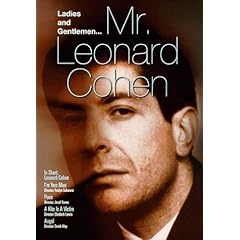 This guy is something else. Kim and I watched this gem of a film last night. What an inspiration! Cohen truly is a genius, a man that will be talked about long after we're all gone. He makes me want to wear a beret and wax poetic about everything I see around me.....and that's saying something!
Let me start out by saying that it is my hope to make movie and album reviews a regular part of Ramblin Round Managua. You see, I'm adding a little structure to this place, tidying up a bit. Every once in a while, one's mind could use a little order I suppose. It should be no different with the articulated thought process, placed upon the electrically clicking display pad that grants a journey within one's mind. So, with that said, here goes....
Leonard Cohen...circa 1965. Canada's public broadcasting channel aired a documentary, chronicling the life and, more important, the 'lifestyle' of its up-and-coming poet. As of the filming of this short black and white film, Cohen had yet to pick up a guitar and put his words to music. He was, first and foremost, a McGill University educated poet, a well-to-do Montreal jew, exploring the boundaries of society through the expanded parameters afforded by his lineage. Given the luxury of financial security and grounded social status, Cohen embarks on a life of bohemian discovery, perusing the dark underbelly of Montreal's streets and the caste of high society, effortlessly and without pretense. He is a child, being reborn every day, asking fundamental questions, discovering the world through an unorthadox lens. Getting a haircut is an adventure, a philosophical endeavor.
In a theme that still rings true to this day, he seeks to preserve the 'self' in an increasingly monolithic, capitalistic Western world. Before the hypocrisy and demise of the youth movement of the 60s became apparent, Cohen illustrates, through his lifestyle, that the preservation of the 'self' is indeed possible. Using the I Ching as his guide, he journeys to Hydra, a remote Greek isle, lacking electricity, cars, and other accoutrements of modernity. There, he observes the world around him, toggling between two worlds, like a poet should I suppose.
Interestingly, two films come to mind immediately when comparing the early life of Mr. Cohen; The Graduate and Don't Look Back. The latter has obvious similarities. In a sense, Dylan's 1965 documentary, 'Don't Look Back' is the American 'answer' to Canada's 'Ladies and Gentlemen, Mr Leonard Cohen'....they are North American bookends throughout the latter half of the twentieth century. In 1965, both are at a crossroads. Cohen with his departure from poetry and into a life of song, and Dylan with his transformation into a rock star, eschewing the role of poet and spokesperson for a generation. Both begin to look inward, exploring the dark realm of 'self' through their music. As for 'The Graduate', well.....the similarities are more superficial. Cohen just kind of looks like Dustin Hoffman's 'Benjamin'. He carries himself the same way, has a waifish, awkward look of an early twentysomething recent graduate. However, Cohen exudes a certain confidence that Hoffman's character only realizes in the last 10 minutes of his film.
In all, I highly recommend this film to anyone that in interested in bohemian lifestyles, poets, the counterculture before it was undermined and debased. Cohen personified everything that was good about the new left in North America. Apolitical now, he was then a leader, a person to be trusted, when during the heady times of the 1960s. I trust he'll be remembered that way as well, through his music and writing. I give this film 5 RR points out of 5. Good day to you all...
Monday, February 26, 2007
Managua Town Redux & Capote

Well, I may have been a little harsh in my last depiction of Managua Town, so I'll try to lighten up a bit. Tomorrow, we're off to another vaunted celebration of 4 year old Nica-dom. Brodie has yet another social engagement, this time with some fellow expats (I think they're Japanese...we'll see) Anyway, I'll let you know how it goes.
In other news, Kim and I finally watched Capote last night. Netflix served up a doozy with this one. For those of you not familiar with Truman Capote, I'll give a little background...
One of the great Southern writers of the latter 20th century, Truman Capote's life started with a bang, and ended with a fizzle. Capote is best known for three things: An eccentric high society gadfly and voyeur, the author of Breakfast At Tiffany's, and later, In Cold Blood, in essence creating the genre of fictional novel.
With the latter, Capote departs the glam, posh, glitz of black tie New York haute couture, and delves into a dark story of murder and mayhem on the remote Kansas plains. Late in 1959, two ex-cons, guided by inside info from the big house, travel to a remote Kansas farmhouse, to rob a wealthy farmer and his family. Instead, they end up murdering the family, and coming away with a measly $50 for their deed. Enter Capote, who, in passing, reads a 300 word snippet in the New York Times about the crime, has an epiphany....thus, he descends upon the devastated little hamlet, with childhood friend, fellow author, and sidekick, Harper Lee (author of the American canon classic, 'To Kill A Mockingbird').
This is where our film essentially begins. Capote is established on New York nightclub circuit, a big personality, well-read it's well known. He reads the othewise insignificant local story about brutal murder in faraway Kansas, decides in the moment, this is the story that he was meant to tell. So, upon arriving in quaint Holcomb, Capote and Lee map out their strategy of acquainting themselves with all of the characters, sifting through details of the personal lives, the crime scene, anchoring themselves to the human pulse of the story, storing away the details, real and imagined. Lee is particularly adept at opening doors, using a feminine comraderie that Capote is unable to perform....at least initially.
In time, Capote's character takes over, a born charmer. He once remarked, 'you are either a writer, or you aren't', alluding to his belief that college was a pointless endeavor for his profession. Telling a story was like an orange. An orange is an orange. There are no questions to be had about it. Stories are the same....if you still have questions after reading the story, or you think it could be told a different way, then, the story isn't very good. If, after reading the story, you are satisfied, and able to move on, then, that is a good story. College cannot teach that. Similarly, some people have charisma, others don't. You cannot teach it. Capote has charisma. In the end, his charm is his undoing, though not shown in the film, save a couple snippets in the closing moments.
He charms the stern sheriff, the sheriff's wife, his scorned lover back east, his editor, Harper Lee, and most importantly, Perry Smith, the trigger man for the grisly murders in Holcomb, Kansas. Perry and Truman end up having a lot in common, both are 'outsiders', a theme Capote uses to manipulate the violent, yet strangely vulnerable Smith. In fact, manipulation proves to be his most adept 'research' skill as a writer. He lies for lying's sake.
At any rate, the bulk of the movie concerns the bond which grows improbably between the two. As Capote's manipulation grows, so does an audience for his much awaited account of the events of that horrible Kansas day. Years drag on, Smith and the other killer, Dick Hickock (such a 'bad guy' name....I cannot imagine many upstanding 'Dick Hickocks' in the world) languish on death row, yet Capote still needs his knockout punch, to justify the Don King-esque zeal in which he has pre-sold his idea and book for his publisher and audience. The intensity and gravity of his deception culminates in the somber realization that Perry Smith will soon be executed. In the end, Capote gets his confession and meaty story of bloodlust, but he pays a price.
A completely changed man, Truman Capote would never write another novel. A truly good movie...dark, intelligent, and a stirring performance by Philip Seymour Hoffman. I give it 4 RRPs (Ramblin' Round Points) out of 5. Wish me luck on the Nica party... I may need the single malt scotch this go 'round.....
Subscribe to:
Posts (Atom)